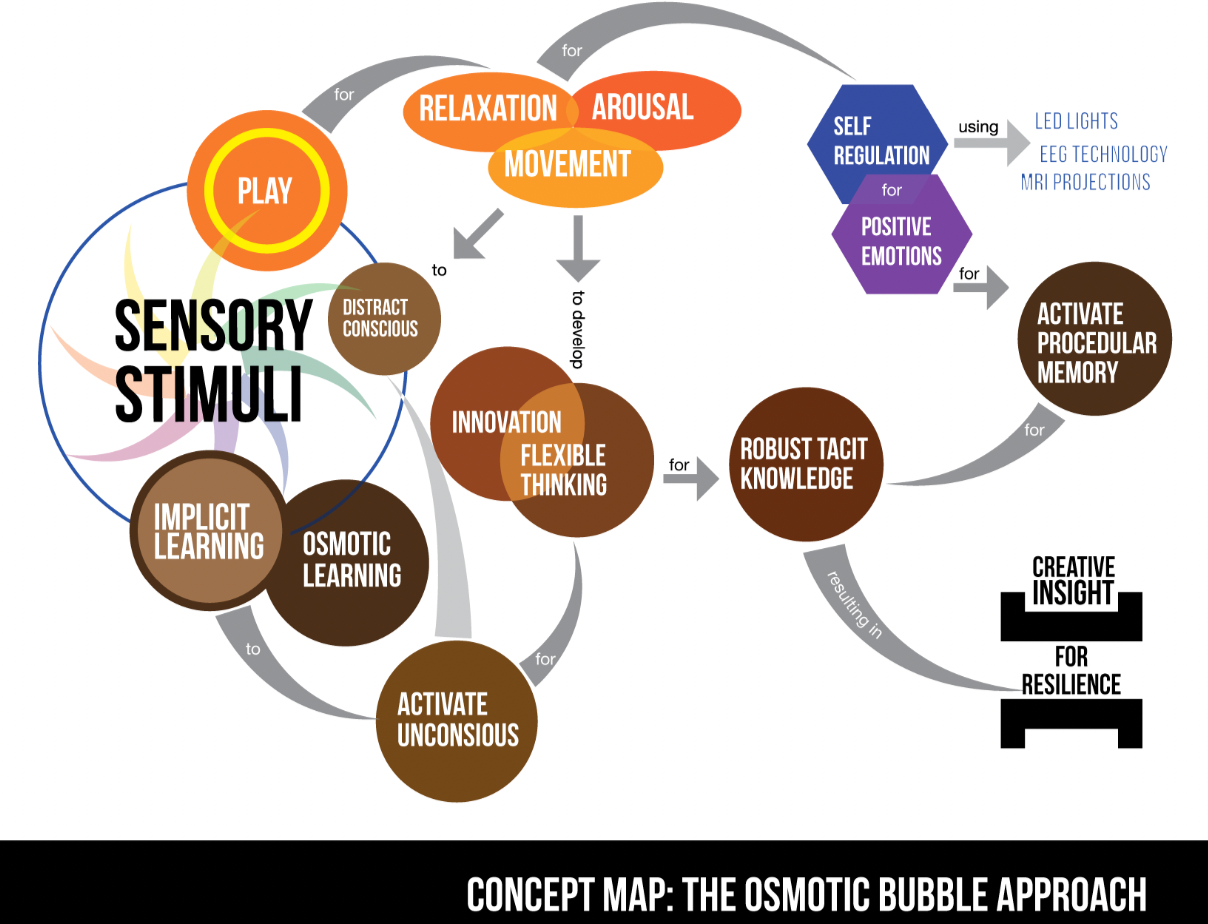
In the midst of the 21st century education is still concerned with the transmission of information rather than nurturing an expansive way of thinking, giving the most value to information retention. Creative capacities are lost when children, in the process of being educated both in the home and at school, are encouraged to memorize over thinking, to follow directions over searching for their own answers. In order to enhance brain capacities and flexible thinking for resilience—and ultimately nurture students’ full potential through thinking and acting—we need to reframe education as the means by which to stimulate all types of intelligences—of cognitive styles; understanding intelligences as interactive, ever-changing, and adaptive cognitive processes that involve sensory stimuli (information input), brain interactivity (learning), and bodily movements (behaviors/actions). I argue that in the same manner that our real- world environment rewires our brain, the space of instruction informs—and trans-forms—our learning experiences, and consequently, fosters a form of implicit learning, one that can be achieved through multisensory environments. However, current models of education use learning spaces as containers with no agency, as opposed to acknowledging the space as a mediator of the learning experience; spaces where the interactions of students with—instead of in—the space, could potentially propel their full potential—spaces with agency. Furthermore, imagination, creativity and independent thinking have to become the academic backbone that uses design[ing] to stimulate brain circuits within learning spaces as a way to nurture creative capacities. The Osmotic Sensoria seeks to demonstrate that a multi-sensorial learning environment——could potentially provide the conditions that enable the production, absorption, and retrieval of tacit knowledge through an organic, osmotic process. The desired outcome is a pedagogy that propels cognitive flexibility and everyday creativity for resilience, through self-regulation, positive emotions, and intuition; playfulness is combined with multisensory stimulation via textures, visual projections, oral narratives, smells, oxygenated air, and kinetic play in order to stimulate the whole brain.
Beyond aesthetics of space & learning: osmotic sensoria, a transitional-learning spaces