In our society, traditional education gives the upmost value to information retention, and concentrates on teaching students specific skills that are deemed important in today’s world, as opposed to encouraging all kinds of innate capacities—of ways of thinking—that prepare young generations for unforeseen futures.
Furthermore, social pressures for high-academic performance and professional success have led students to illegally consume and abuse amphetamine salts-based psycho-stimulants—such as Adderall and Ritalin; these drugs have become trendy, and are highly consumed amongst college students looking to gain focused attention, work long hours, and retain more information for short periods of time in order to attain higher performance in test scores. Design education is no different; in my role as a design educator and practitioner I have been concerned with my students’ complaints about losing their creative juices once in design school. When confronted with systematic design methodologies, students become handicapped, incapable of embracing their creative capabilities to the fullest because, even when asked to “think outside the box,” there is a limit to the outsideness of that box; a limit defined by cultural biases, grades, and social validation. By the same token, the weight to demonstrate “talent,” “creativity,” and “originality,” while also having to conform to social conventions weakens students’ innate ability to thrive in a world that is in need—and yet not ready—of independent thinkers, pioneers, and innovators.
In shaping education for the 21st Century, both neuroscience and design[ing] need to become the core of educational systems—neuroscience as the basis to understand and harness human capabilities and design[ing] as the means by which to develop and enact such capacities in everyday life; similar to homeostasis—the ability of systems to regain and maintain a state of balance—design education needs to aim for heterotopia, which in scientific terms describes the shift of healthy tissue to “wrong” places causing vivacious activation. In this paper.
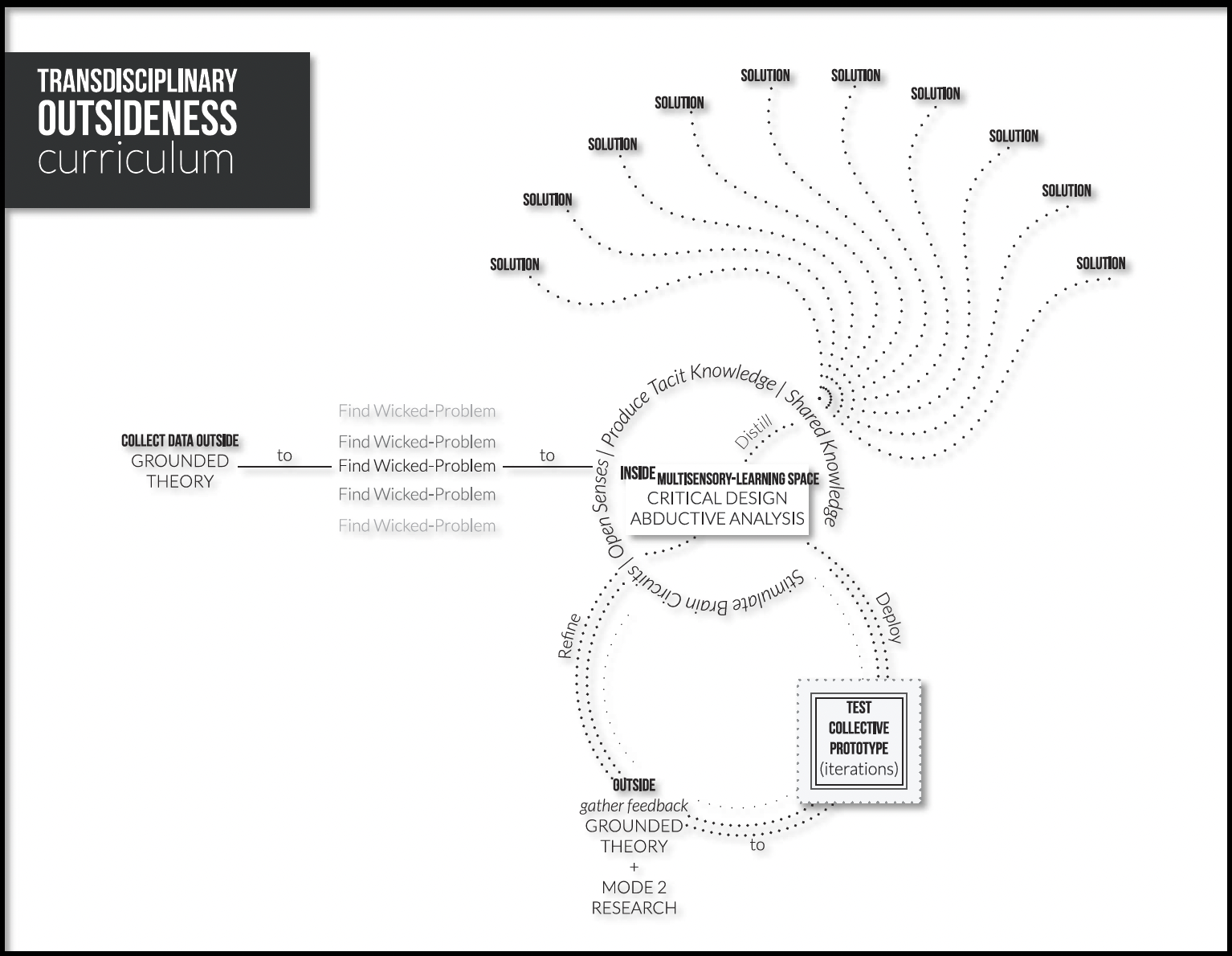
I will discuss a multisensory-implicit approach for teaching and learning: a process of Transdisciplinary- Outsideness shaped in a curriculum that integrates Critical Design + Grounded Theory + M2 Research + Design[ing] as a mode of inquiry, serendipitous research, co-participation and co-creation, constructive provocation, and social change, beyond the confinements of practicing Affirmative Design, and those of the classroom space. In order to enhance brain capacities and flexible thinking for resilience, and ultimately nurture students’ full potential through thinking and acting, we need to reframe design education as the means by which to naturally, and organically, stimulate all types of intelligences—of cognitive styles; acknowledging intelligences as independent from “what it is known,” and instead understand intelligence as interactive, everchanging, and adaptive cognitive processes that involve sensory stimuli (information input), brain interactivity (learning), and bodily movements (behaviours/actions).
The current educational paradigm is ill defined—it is a disservice to students’ growth both as professionals andas global citizens of the world. We need a radical change in education, a new paradigm that strives for the expansion of minds beyond grades, tests, and drugs. The main goal of a Transdisciplinary-Outsideness curriculum is to exercise cognitive flexibility in order to nurture innate capacities by provoking new discourses that challenge the status quo, instead of mending the everyday of today’s world.